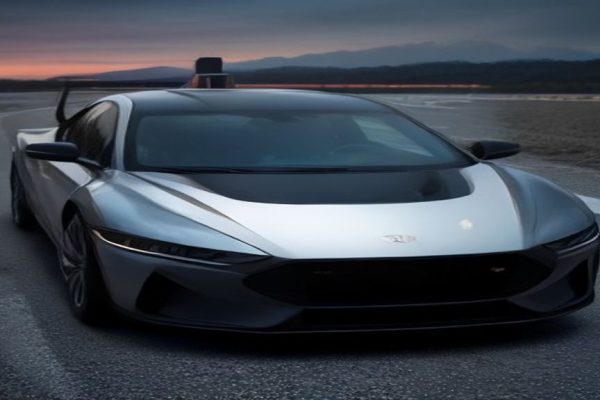
Chinese Cars Take Center Stage in the Self-Driving Revolution
The autonomous vehicle industry has seen significant advancements in recent years, with companies around the world racing to develop and deploy self-driving cars. In this conversation, Xinzhou Wu, a prominent figure in the field, shares his insights on the role of Chinese companies in this revolution and the importance of lidar technology in achieving true autonomy.
Background and Context
The autonomous vehicle industry has been driven by a combination of technological advancements and increasing government regulations. As governments around the world begin to set clear guidelines for the deployment of self-driving cars, companies are racing to develop and deploy these vehicles. Chinese companies, in particular, have made significant strides in this field, with companies like Baidu, Alibaba, and Geely investing heavily in autonomous vehicle research and development.
Xinzhou Wu, a renowned expert in the field, has been instrumental in shaping the autonomous vehicle industry in China. His work has focused on the development of autonomous driving systems, including the use of lidar technology. In this conversation, Wu shares his insights on the role of Chinese companies in the self-driving revolution and the importance of lidar technology in achieving true autonomy.
The Role of Lidar in Autonomous Vehicles
Lidar technology, which uses lasers to create high-resolution 3D maps of the environment, has been a crucial component in the development of autonomous vehicles. Companies like Waymo and Tesla have used lidar to achieve impressive results in self-driving car testing, but Wu argues that the technology is still in its early stages.
“Lidar is an essential tool for creating accurate 3D maps of the environment,” Wu explains. “But it’s not the only technology needed for true autonomy. We need to integrate lidar with other sensors, like cameras and radar, to achieve a complete understanding of the environment.”
Chinese Companies and the Autonomous Vehicle Industry
Chinese companies have made significant strides in the autonomous vehicle industry, with companies like Baidu and Geely investing heavily in research and development. Wu believes that Chinese companies have a unique advantage in this field, thanks to the country’s vast resources and infrastructure.
“China has a significant lead in terms of resources and infrastructure,” Wu says. “We have a large population, a well-developed manufacturing sector, and a strong focus on innovation. This has allowed us to make significant strides in autonomous vehicle research and development.”
The Future of Autonomous Vehicles
As the autonomous vehicle industry continues to evolve, Wu believes that Chinese companies will play a significant role in shaping the future of self-driving cars. He argues that the industry will require a combination of technological advancements and increasing government regulations to achieve widespread adoption.
“The future of autonomous vehicles will depend on a combination of technological advancements and government regulations,” Wu says. “We need to integrate lidar with other sensors to achieve true autonomy, and governments need to set clear guidelines for the deployment of self-driving cars.”
Conclusion
As the autonomous vehicle industry continues to evolve, Xinzhou Wu’s insights on the role of Chinese companies and the importance of lidar technology offer a unique perspective on the future of self-driving cars. Wu’s work has focused on the development of autonomous driving systems, including the use of lidar technology, and his insights will be essential in shaping the future of this industry.






Leave a Reply