Climate Change Turns into a Galactic Problem: Wildfires Disrupt US Space Observatories
The recent wildfires in Spain have spread to unforeseen reaches, disrupting critical astronomical observations. The blaze has overrun one of three observatories used by the US National Aeronautics and Space Administration (NASA) to connect with its Deep Space Network (DSN) facilities worldwide.
Understanding the Importance of the Deep Space Network
The Deep Space Network is a collection of large antennas and communication facilities used by NASA to track and communicate with spacecraft throughout the solar system. It plays a vital role in the exploration of our cosmos, enabling real-time communication with space agencies around the world and facilitating the transmission of vital data from space.
The network consists of three main facilities located in Goldstone, California; Madrid, Spain; and Canberra, Australia. Each facility houses a 70-meter (230 ft) diameter antenna that is capable of transmitting and receiving signals from spacecraft located hundreds of millions of miles away.
The Madrid facility, which has been impacted by the wildfires, is one of the most critical nodes in the DSN. Its unique location allows it to serve as a hub for communication with spacecraft in the eastern hemisphere, enabling NASA to establish a robust connection with the International Space Station, Mars rovers, and other vital missions.
- The Madrid facility is equipped with a 70-meter (230 ft) diameter antenna that is capable of transmitting and receiving signals from spacecraft located hundreds of millions of miles away.
- The facility serves as a hub for communication with spacecraft in the eastern hemisphere, enabling NASA to establish a robust connection with the International Space Station, Mars rovers, and other vital missions.
- The Madrid facility is also used to track and communicate with spacecraft in the European Space Agency’s (ESA) constellation, including the Gaia spacecraft, which is mapping the Milky Way galaxy.
Climate Change: A Growing Concern for Space Exploration
The recent wildfires in Spain are just one of many examples of how climate change is impacting space exploration. Rising temperatures and changing weather patterns are causing wildfires to spread rapidly across the globe, threatening critical infrastructure and disrupting vital missions.
Climate change is also affecting the accuracy of astronomical observations, as changing atmospheric conditions alter the readings obtained by telescopes and other instruments. This can have significant implications for scientists studying the universe, as even small changes in atmospheric conditions can skew the results of crucial observations.
A Galactic Problem Requiring a Global Solution
The recent wildfires in Spain highlight the need for a coordinated global response to the challenges posed by climate change. As the effects of climate change continue to spread across the globe, it is essential that space agencies, governments, and other stakeholders work together to mitigate the impacts of these changes on space exploration.
This will require a concerted effort to develop and implement strategies for mitigating the effects of climate change on space infrastructure, including the development of more resilient and adaptable systems, as well as the implementation of emergency response plans to protect critical infrastructure from the impacts of wildfires and other natural disasters.
The disruption caused by the wildfires in Spain serves as a stark reminder of the need for a galactic strategy to address the challenges posed by climate change. By working together, we can ensure that the wonders of the universe continue to be explored and understood, even as the effects of climate change continue to unfold.
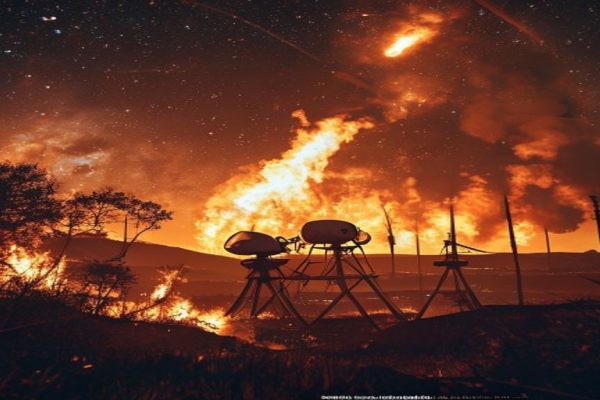
Image prompt: A dramatic image of the wildfires engulfing the Madrid DSN facility, with a 70-meter (230 ft) diameter antenna looming in the foreground, surrounded by flames and smoke. The image should convey a sense of urgency and danger, highlighting the impact of climate change on critical space infrastructure.
Category: Technology






Leave a Reply