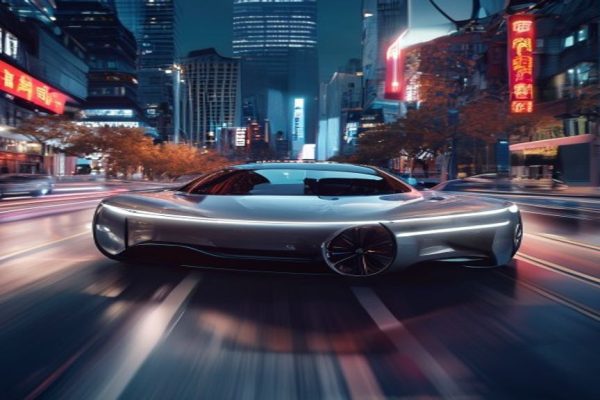
China’s Ambitious Push for Autonomous Vehicles: Insights from Xinzhou Wu
As the world witnesses a rapid shift towards electric and autonomous vehicles, China is emerging as a frontrunner in the self-driving revolution. In a recent interview, Xinzhou Wu, a key figure in China’s autonomous vehicle (AV) ecosystem, shed light on the country’s plans, challenges, and technological advancements in the field. In this article, we’ll delve into Wu’s insights and explore what they mean for the global automotive industry.
Xinzhou Wu: A Pioneer in China’s Autonomous Vehicle Ecosystem
Xinzhou Wu is the chief engineer at Xiaopeng Motors, a Chinese electric vehicle (EV) manufacturer that has been at the forefront of autonomous driving technology. With a background in computer science and robotics, Wu has played a crucial role in developing Xiaopeng’s autonomous driving system, which has been deployed on several production vehicles. His expertise and experience make him an ideal source of information on China’s AV landscape.
China’s Ambitious Plans for Autonomous Vehicles
China has set ambitious targets for the adoption of autonomous vehicles, with the government aiming to have 50% of new vehicles sold in the country be autonomous by 2025. This goal is part of China’s broader plan to become a global leader in the development and deployment of AV technology. Wu believes that China’s unique combination of factors, including its massive market, advanced technology, and favorable regulatory environment, positions it well to achieve this goal.
However, Wu also acknowledged the significant challenges that China faces in its push for autonomous vehicles. These include the need for massive investments in infrastructure, the development of robust cybersecurity measures, and the creation of a regulatory framework that balances innovation with public safety. Despite these challenges, Wu remains optimistic about China’s prospects, citing the country’s ability to rapidly deploy new technologies and scale up production.
The Role of Lidar in Autonomous Vehicles
One of the most significant technological hurdles in the development of autonomous vehicles is the use of lidar (light detection and ranging) sensors. These sensors use laser light to create high-resolution 3D maps of the environment, allowing vehicles to detect objects and navigate safely. However, lidar technology is still in its infancy, and many experts believe that it is not yet ready for widespread adoption.
Wu disagrees with this assessment, arguing that lidar technology has made significant progress in recent years and is now ready for deployment in production vehicles. He believes that the key to successful lidar deployment lies in the development of more advanced algorithms that can integrate data from multiple sensors, including cameras, radar, and lidar. By doing so, Wu argues that lidar can provide a more comprehensive view of the environment, enabling vehicles to detect objects and navigate safely even in complex scenarios.
Future Implications for the Global Automotive Industry
Xinzhou Wu’s insights into China’s autonomous vehicle ecosystem offer a glimpse into a future where AVs are not just a novelty but a mainstream reality. As China continues to push the boundaries of AV technology, the global automotive industry will be forced to adapt and innovate in response. This may involve significant investments in research and development, the deployment of new technologies such as lidar, and the creation of new business models that take into account the changing needs of consumers.
In conclusion, Xinzhou Wu’s comments on China’s autonomous vehicle plans and the role of lidar technology offer a fascinating glimpse into a future where AVs are not just a possibility but a reality. As the world continues to watch China’s progress in this field, it is clear that the country is poised to play a leading role in the development and deployment of autonomous vehicles.






Leave a Reply