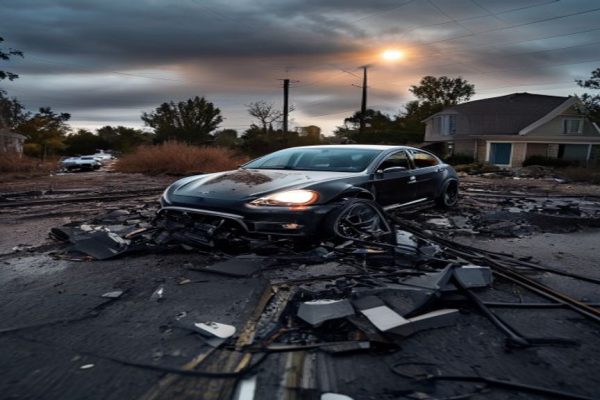
Fatal Crash in Katy, Texas Sparks Investigation into Tesla’s Autopilot System
A devastating crash in Katy, Texas, this past weekend has left a woman dead and raised concerns about the safety of Tesla’s Autopilot system. The incident has sparked an investigation by local authorities and has sparked a heated debate about the limitations and reliability of advanced driver-assistance technologies (ADAS) in vehicles.
The crash occurred on June 19 around 8:03 p.m. when Michael Butler, the driver of a 2021 Tesla Model S, collided with a tree in a residential area. Butler, 38, allegedly had the Autopilot system engaged at the time of the crash, which is designed to assist drivers with steering, acceleration, and braking.
According to the police report, Butler was driving on a winding road when his vehicle veered off the road and crashed into a tree. The 69-year-old woman, who was a passenger in the vehicle, was pronounced dead at the scene. Butler was taken to a local hospital with non-life-threatening injuries.
Background on Teslas Autopilot System
Tesla’s Autopilot system is a sophisticated ADAS that uses a combination of cameras, radar, and ultrasonic sensors to assist drivers with steering, acceleration, and braking. The system is designed to enable semi-autonomous driving, allowing drivers to take their hands off the wheel in certain situations, such as on the highway.
However, Autopilot has been the subject of controversy in the past, with several high-profile crashes and fatalities reported. In 2016, a Tesla Model S crashed into a tractor-trailer in Florida, killing the driver, who was using the Autopilot system at the time. The National Highway Traffic Safety Administration (NHTSA) and the National Transportation Safety Board (NTSB) investigated the crash and found that the Autopilot system was not designed to detect the tractor-trailer, which was not visible to the cameras and sensors.
Limitations and Risks of ADAS
The fatal crash in Katy, Texas, highlights the limitations and risks of ADAS in vehicles. While these systems can improve safety by reducing the risk of human error, they are not foolproof and can be vulnerable to various hazards, including:
- Lack of visibility: ADAS systems can be designed to detect certain objects or hazards, but they may not be able to detect others, such as pedestrians, animals, or road debris.
- Software limitations: ADAS systems are only as good as the software that powers them. If the software is flawed or outdated, the system may not function as intended.
- Human error: Drivers may rely too heavily on ADAS systems, leading to complacency and a reduced ability to respond to unexpected situations.
As the use of ADAS in vehicles continues to grow, it is essential to address these limitations and risks. Manufacturers, regulators, and consumers must work together to ensure that these systems are designed and implemented safely and responsibly.
In the wake of the fatal crash in Katy, Texas, Tesla has not commented on the incident. However, the company has stated that it is committed to improving the safety and reliability of its Autopilot system. The NHTSA and the NTSB have launched an investigation into the crash, and the results are expected to be released in the coming weeks.
As the investigation unfolds, it is essential to keep in mind that the use of ADAS in vehicles is still in its early stages. While these systems have the potential to revolutionize the way we drive, they also pose unique risks and challenges that must be addressed.






Leave a Reply