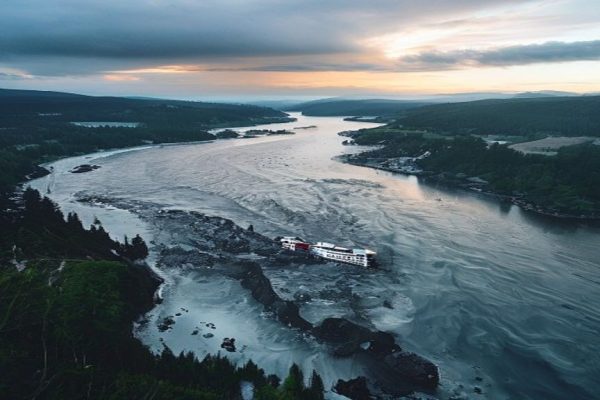
Landslide Triggers Catastrophic Tsunami in Alaska’s Tracy Arm Fjord
The early morning hours of August 10, 2025, brought catastrophic news to the small town of Juneau in Alaska. A massive landslide occurred in the Tracy Arm fjord, a picturesque destination for many cruise lines, triggering a 1,578-foot-tall (481-meter-tall) mega-tsunami that has left a trail of destruction in its wake.
Background and Context
The Tracy Arm fjord is a narrow, glacier-carved channel that empties into the Gulf of Alaska. Its stunning beauty and unique wildlife make it a magnet for tourists, with cruise lines often including it in their itineraries. However, the fjord’s geography and geology make it prone to landslides and glacial calving, which have been increasing in frequency and severity due to climate change.
While landslides and tsunamis are not uncommon in Alaska, the sheer scale and impact of this event has caught the scientific community and emergency responders off guard. The landslide is believed to have been triggered by a combination of heavy rainfall, thawing permafrost, and the instability of the fjord’s rock face.
Impact on Cruise Industry and Local Communities
The impact of the landslide and resulting tsunami on the cruise industry is expected to be significant. Many cruise lines have already canceled or altered their itineraries to avoid the affected area, while others are scrambling to assess the damage and respond to the crisis. The loss of revenue and the potential long-term impact on the industry’s reputation could be substantial.
Locally, the impact is also being felt. The town of Juneau, which relies heavily on tourism, is bracing for the economic fallout of the disaster. The fjord’s unique ecosystem, home to a diverse array of wildlife, including bears, whales, and sea birds, is also under threat. The long-term consequences of the landslide and tsunami on the fjord’s delicate balance are still unknown but could be devastating.
Environmental Concerns and Future Implications
The landslide and resulting tsunami have raised serious concerns about the long-term impact of climate change on Alaska’s fragile environment. Rising temperatures are causing permafrost to thaw, making the state’s geology increasingly unstable. This has been exacerbated by heavy rainfall events, which are becoming more frequent and intense due to climate change.
The event also highlights the need for more effective disaster preparedness and response strategies in Alaska. While emergency responders and scientists are working tirelessly to assess the damage and coordinate relief efforts, the full extent of the disaster is still unknown. The importance of investing in climate resilience and disaster mitigation measures cannot be overstated.
As the world watches the unfolding crisis in Alaska, one thing is clear: the impact of the landslide and tsunami will be felt for years to come, with far-reaching consequences for the environment, local communities, and the global community.
Key Points:
- A massive landslide occurred in Alaska’s Tracy Arm fjord on August 10, 2025, triggering a 1,578-foot-tall (481-meter-tall) mega-tsunami.
- The landslide is believed to have been triggered by a combination of heavy rainfall, thawing permafrost, and the instability of the fjord’s rock face.
- The impact on the cruise industry is expected to be significant, with many cruise lines canceling or altering their itineraries.
- The long-term consequences of the landslide and tsunami on the fjord’s delicate ecosystem are still unknown but could be devastating.
- The event highlights the need for more effective disaster preparedness and response strategies in Alaska and the importance of investing in climate resilience and disaster mitigation measures.
This is a developing story, and updates will be provided as more information becomes available.






Leave a Reply