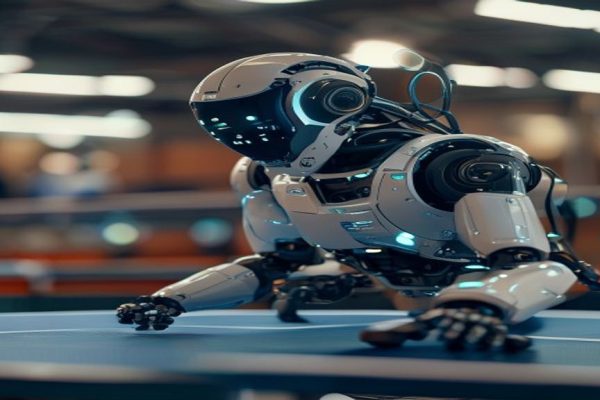
Revolutionizing Table Tennis with AI-Powered Robots
The world of table tennis is on the cusp of a revolution, thanks to the innovative work of Sony AI researchers. Their creation, a robot named Ace, has set its sights on becoming the world champion of the sport. This ambitious goal is not just a novelty; it’s a testament to the rapid advancements being made in artificial intelligence and robotics.
Ace is more than just a machine; it’s a sophisticated robot designed to mimic the skills of a human table tennis player. Equipped with advanced sensors and AI algorithms, Ace can track and respond to the movements of its opponents with lightning-fast speed and accuracy. The researchers behind Ace believe that their creation has the potential to redefine the boundaries of human performance in table tennis.
Background and Context
Table tennis, also known as ping pong, is a highly demanding sport that requires a unique combination of speed, agility, and strategy. The sport has a rich history, dating back to the 19th century, and has evolved over the years to become one of the most popular recreational activities worldwide. However, the rise of AI-powered robots like Ace raises questions about the future of human competition in the sport.
The study published in Nature provides insights into the development and capabilities of Ace. According to the researchers, the robot’s AI system is based on a deep learning approach, which enables it to learn and adapt to new situations quickly. This adaptability is crucial in table tennis, where players need to respond to changing circumstances and opponents’ strategies.
Key Features and Capabilities of Ace
- Advanced Sensors: Ace is equipped with high-resolution sensors that allow it to track the movement and spin of the ball with precision.
- AI-Powered Algorithms: The robot’s AI system uses machine learning algorithms to analyze the game and make decisions in real-time.
- Lightning-Fast Speed: Ace can move at incredible speeds, allowing it to cover the table in a fraction of the time it takes a human player.
- Adaptability: The robot’s AI system enables it to adapt to new situations and opponents’ strategies quickly.
The researchers behind Ace believe that their creation has the potential to revolutionize the world of table tennis. By providing a new benchmark for human performance, Ace challenges players to push their limits and strive for excellence. The robot’s ability to analyze and respond to the game in real-time also offers insights into the underlying mechanics of table tennis, which can be used to improve the sport and enhance player performance.
Future Implications and Challenges
The rise of AI-powered robots like Ace raises questions about the future of human competition in table tennis. While some players may see Ace as a threat, others may view it as an opportunity to learn from and improve against a cutting-edge opponent. The researchers behind Ace acknowledge that the robot’s capabilities may eventually surpass those of human players, but they believe that this can be a positive development for the sport.
The study published in Nature highlights the potential of AI-powered robots to revolutionize various aspects of human life, from sports to healthcare and beyond. As we continue to push the boundaries of AI and robotics, it’s essential to consider the implications of these advancements and their potential impact on society.






Leave a Reply