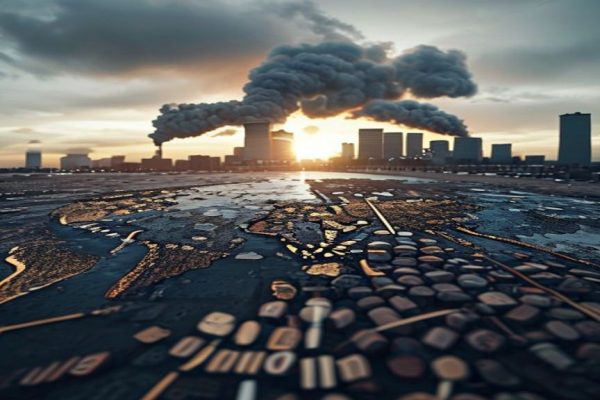
The Financial Burden of Climate Change
The world’s largest carbon emitters are facing a mounting bill for the devastating impact of climate change on future generations. According to experts, the damage caused by greenhouse gas emissions can be quantified financially, providing a stark reminder of the consequences of inaction.
The concept of a carbon debt has gained traction in recent years, with some estimates suggesting that the world’s largest emitters owe a staggering sum to future generations. This debt is not just a moral obligation, but a financial one, with experts arguing that it can be calculated and paid off.
The idea of a carbon debt is based on the principle that the benefits of fossil fuel consumption are enjoyed by current generations, while the costs of climate change are borne by future generations. By quantifying this debt, experts hope to create a sense of accountability among governments and corporations, and to encourage them to take action to reduce their carbon footprint.
Calculating the Carbon Debt
So how do experts calculate the carbon debt? It’s a complex process that takes into account a range of factors, including the amount of greenhouse gases emitted, the impact of those emissions on the environment, and the economic costs of mitigating or adapting to climate change.
One way to calculate the carbon debt is to use a technique called ‘cost-benefit analysis.’ This involves estimating the costs of climate change, such as damage to infrastructure, loss of productivity, and increased healthcare costs, and comparing them to the benefits of fossil fuel consumption, such as economic growth and energy security.
According to a recent study, the world’s largest carbon emitters owe a total of around $1.3 trillion to future generations. This includes $430 billion owed by the United States, $270 billion owed by China, and $140 billion owed by the European Union.
The Future Implications of Climate Change
The financial implications of climate change are just the tip of the iceberg. The long-term consequences of rising temperatures, more intense natural disasters, and changes to ecosystems will have far-reaching impacts on human societies and economies.
In the next decade, we can expect to see more frequent and severe heatwaves, droughts, and storms, which will have devastating impacts on agriculture, infrastructure, and human health. The economic costs of adapting to these changes will be substantial, and will likely be borne by future generations.
Key points to consider:
- The world’s largest carbon emitters owe a total of around $1.3 trillion to future generations.
- The carbon debt is calculated using a cost-benefit analysis, which estimates the costs of climate change and compares them to the benefits of fossil fuel consumption.
- The financial implications of climate change will have far-reaching impacts on human societies and economies.
- The long-term consequences of rising temperatures, more intense natural disasters, and changes to ecosystems will be devastating.
The world’s largest carbon emitters must take action to reduce their carbon footprint and mitigate the impacts of climate change. This requires a coordinated effort from governments, corporations, and individuals to transition to renewable energy sources, increase energy efficiency, and protect natural ecosystems.
The time to act is now. The future of our planet depends on it.
Image Prompt: A dramatic illustration of a planet being ravaged by climate change, with a giant clock ticking in the background, symbolizing the urgency of the situation. The image should be in a futuristic style, with bold lines and vibrant colors, and should include a prominent carbon footprint or emissions symbol in the foreground.
Category: Business






Leave a Reply