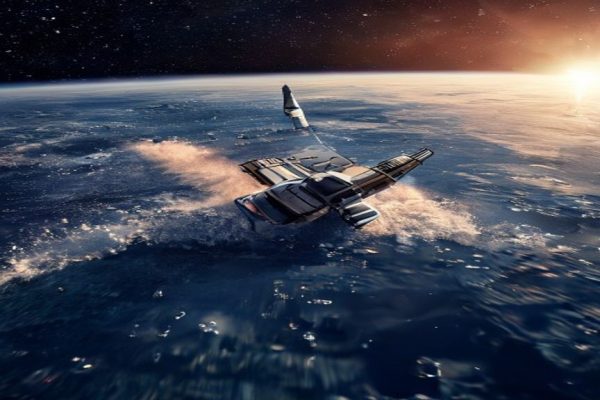
Revolutionizing Deep-Space Exploration: The Water Propulsion Breakthrough
Humanity’s plans for deep-space exploration have long been hindered by the limitations of traditional rocket propulsion systems. However, a recent breakthrough in using water as a propellant has opened up new possibilities for interplanetary travel. This innovative technology has the potential to revolutionize the field of space exploration, enabling us to venture farther into the solar system than ever before.
For decades, scientists have been searching for a way to harness the power of water to propel spacecraft. The idea is simple: water is abundant in space, and when it’s heated to high temperatures, it produces a significant amount of thrust. However, the challenge lies in developing a system that can efficiently and safely utilize this energy source.
The Science Behind Water Propulsion
Water propulsion systems work by using a combination of heat and pressure to vaporize water, which is then expelled through a nozzle to create thrust. This process is similar to the way a traditional rocket engine works, but with some key differences. Water propulsion systems are more efficient, produce less waste, and can even be powered by solar energy.
- Efficiency: Water propulsion systems can achieve higher specific impulse (a measure of efficiency) than traditional rocket engines, making them more fuel-efficient.
- Reduced Waste: The only byproduct of water propulsion is water vapor, which is cleaner and more environmentally friendly than traditional rocket exhaust.
- Solar Power: Water propulsion systems can be powered by solar energy, reducing the need for expensive and heavy fuel.
The Future of Deep-Space Exploration
The implications of water propulsion technology are far-reaching, with the potential to transform the field of space exploration. With this technology, we can send spacecraft farther and faster than ever before, enabling us to explore the outer reaches of the solar system and beyond.
One of the most significant benefits of water propulsion is its ability to enable long-duration missions. Traditional rocket engines are limited by the amount of fuel they can carry, which restricts the distance and duration of a mission. Water propulsion systems, on the other hand, can be refueled with water from asteroids or comets, allowing for continuous propulsion and extended mission durations.
The potential applications of water propulsion technology are vast, from sending manned missions to Mars and beyond, to exploring the outer planets and their moons. This technology has the power to unlock new frontiers and expand our understanding of the universe.
As we continue to push the boundaries of space exploration, it’s clear that water propulsion technology will play a critical role in our future endeavors. With its efficiency, reduced waste, and solar power capabilities, this innovative technology has the potential to revolutionize the way we travel through space, enabling us to explore the cosmos like never before.
In conclusion, the breakthrough in water propulsion technology marks a significant milestone in the history of space exploration. As we look to the future, it’s clear that this technology will be a key driver of innovation and discovery, enabling us to explore the unknown and push the boundaries of what’s possible.
Image Prompt: A futuristic illustration of a spacecraft propelled by a water propulsion system, with a massive asteroid or comet in the background, providing a source of water for refueling. The spacecraft is depicted in orbit around a distant planet, with a clear blue sky and a stunning starry night sky in the background.






Leave a Reply