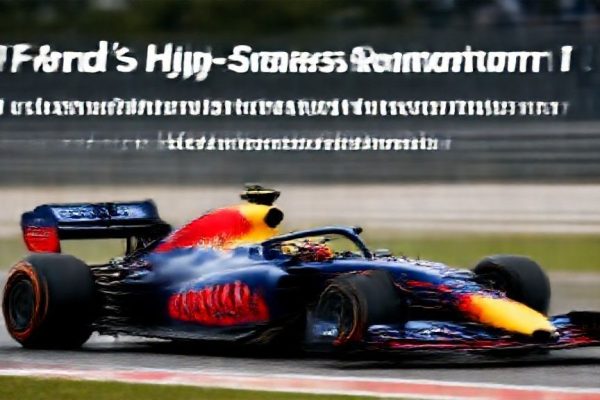
Ford’s High-Stakes Return to Formula 1: Lessons Learned from Red Bull Engine Development
Ford, the iconic American automobile manufacturer, is making a bold move by reentering the highly competitive world of Formula 1 (F1) racing. The company’s decision to return to F1 comes after a nearly two-decade absence, and it marks a significant shift in their strategic focus. In a recent interview, Jim Farley, Ford’s CEO, revealed that the company’s experience developing the Red Bull F1 engine has taught him valuable lessons that will help them succeed in the cutthroat software industry.
Background on Ford’s Return to F1
Formula 1 racing is a global phenomenon, with a massive following and a reputation for pushing the boundaries of innovation and technology. The series is a proving ground for the world’s top engineers and manufacturers, who compete to create the fastest, most efficient, and most advanced racing cars on the planet. When Ford announced its decision to return to F1, it sent shockwaves throughout the industry, sparking excitement and curiosity among fans and analysts alike.
Ford’s decision to reenter F1 is driven by a desire to leverage the series’ global reach and reputation for innovation to promote its brand and advance its technological capabilities. The company sees F1 as an opportunity to develop and test new technologies that can be applied to its consumer vehicles, as well as to tap into the series’ vast network of fans and partners.
Lessons Learned from Red Bull Engine Development
When Ford partnered with Red Bull Racing to develop a bespoke F1 engine, they gained valuable insights into the complexities of engine design, development, and testing. According to Farley, the experience taught them the importance of collaboration, open communication, and data-driven decision-making in achieving success in the highly competitive world of F1.
The partnership also highlighted the critical role that artificial intelligence (AI) and machine learning (ML) play in optimizing engine performance and efficiency. Ford’s engineers worked closely with Red Bull’s data scientists to develop sophisticated algorithms that enabled them to analyze vast amounts of data, identify areas for improvement, and make data-driven decisions to optimize engine performance.
These lessons will be crucial as Ford navigates the software industry, where collaboration, open communication, and data-driven decision-making are essential for success. By applying the principles they learned from their F1 experience, Ford aims to stay ahead of the competition and drive innovation in the software space.
Future Implications and Challenges
Ford’s return to F1 marks a significant shift in its strategic focus, and the company faces several challenges as it navigates this new frontier. One of the biggest challenges will be to adapt its existing organizational structure and culture to accommodate the demands of F1 racing. The series requires a high degree of specialization and expertise, which can be difficult to integrate with Ford’s existing business operations.
Additionally, Ford will need to navigate the complex web of regulations and technical rules that govern F1 racing. The series is known for its strict technical regulations, which can be challenging to navigate, especially for a company that is new to the series.
Despite these challenges, Ford’s return to F1 is a bold and exciting move that has the potential to drive innovation and growth for the company. By leveraging the series’ global reach and reputation for innovation, Ford can promote its brand, advance its technological capabilities, and tap into the series’ vast network of fans and partners.
As Ford embarks on this new chapter in its history, it will be interesting to see how the company applies the lessons it learned from Red Bull engine development to succeed in the software industry. One thing is certain: Ford’s return to F1 marks a new era of innovation and competition in the world of motorsports.
Conclusion
Ford’s decision to return to F1 is a significant move that marks a new chapter in the company’s history. By leveraging the series’ global reach and reputation for innovation, Ford can promote its brand, advance its technological capabilities, and tap into the series’ vast network of fans and partners. The lessons learned from Red Bull engine development will be crucial in driving innovation and growth in the software industry, and it will be exciting to see how Ford applies these principles to succeed in this new frontier.
As the F1 season heats up, fans and analysts will be watching closely to see how Ford performs on the track. With its rich history, innovative spirit, and commitment to excellence, Ford is poised to make a strong impact in the world of F1 racing.






Leave a Reply