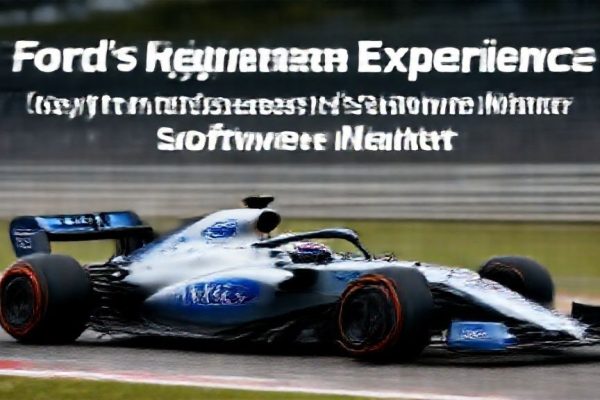
Ford’s High-Stakes Reentry into Formula 1 Racing
Ford, one of the world’s leading automobile manufacturers, has announced its return to Formula 1 racing after a 20-year hiatus. This bold move comes with significant investments and a commitment to designing and manufacturing the power units for its own F1 team. The company’s decision to reenter the high-stakes world of F1 racing is shrouded in strategic reasoning, as revealed by Jim Farley, CEO of Ford, in a recent statement.
Lessons Learned from Red Bull F1 Engine Collaboration
In an interview with a leading business publication, Farley emphasized that his experience working with the Red Bull F1 engine team has taught him valuable lessons that will be instrumental in beating China in the software game. Although the specifics of this statement are unclear, industry insiders speculate that Farley’s comments might be referring to the intense competition and cutting-edge technology that define the F1 racing environment.
By collaborating with Red Bull, a renowned F1 team, Ford likely gained insights into the complexities of engine design, aerodynamics, and data analysis – all critical components of F1 racing. These lessons might be transferable to the software development arena, where Ford aims to establish itself as a major player.
Implications for Ford’s China Strategy
The automotive giant’s reentry into F1 racing is closely tied to its ambitions in the Chinese market, where the company is seeking to expand its presence in the burgeoning electric vehicle (EV) segment. China is the world’s largest EV market, and Ford aims to capitalize on this trend by introducing its own line of eco-friendly vehicles.
However, China’s highly competitive EV market is dominated by local players such as BYD and Geely, making it an extremely challenging environment for foreign manufacturers. Ford’s experience in F1 racing might provide a unique advantage in this market, as the company’s engineers and researchers develop cutting-edge technology that can be applied to its EV products.
Beating China in the software game, as Farley mentioned, could be a reference to the country’s dominance in the global software development landscape. With China being home to some of the world’s leading tech companies, including Alibaba and Tencent, the country’s software industry is a major player in the global market.
Future Prospects and Challenges
Ford’s reentry into F1 racing is a multi-year project that will see significant investments in research and development, as well as the establishment of a new F1 team. While the company’s experience in F1 racing could provide valuable insights into the software development arena, there are also challenges that lie ahead.
One of the primary concerns is the intense competition in the Chinese EV market, where local players have a significant advantage due to their existing infrastructure and networks. Additionally, the company’s ability to transfer its F1 racing expertise into the software development arena will be crucial in determining its success in the Chinese market.
- Ford’s reentry into Formula 1 racing marks a significant shift in the company’s strategy, with a focus on designing and manufacturing its own F1 power units.
- Jim Farley’s experience working with the Red Bull F1 engine team has taught him valuable lessons that will be instrumental in beating China in the software game.
- The company’s ambitions in the Chinese market are closely tied to its EV strategy, where Ford aims to establish itself as a major player in the burgeoning market.
- Ford’s experience in F1 racing might provide a unique advantage in the Chinese EV market, where the company’s engineers and researchers develop cutting-edge technology that can be applied to its EV products.
In conclusion, Ford’s reentry into Formula 1 racing is a bold move that reflects the company’s commitment to innovation and competition. While the challenges ahead are significant, the company’s experience in F1 racing could prove to be a key factor in its success in the Chinese market, where software development and EV technology are increasingly intertwined.
As Ford continues to navigate the high-stakes world of F1 racing, it will be exciting to see how the company’s expertise in this arena translates into its software development and EV strategies in China.






Leave a Reply