Tesla’s Autonomous Robotaxis: A Leap Forward or a Regulatory Quagmire?
In a recent milestone, Tesla CEO Elon Musk celebrated the achievement of its autonomous robotaxis, marking a significant step towards the future of transportation. However, the question remains: how many people will be able to ride in these unsupervised vehicles in the immediate future?
Background and Context
Tesla’s push towards autonomous technology has been a long-standing endeavor, with the company investing heavily in the development of its Autopilot system. The latest achievement brings the company closer to its goal of creating a fully autonomous transportation network. However, regulatory hurdles and public concerns about safety remain major obstacles to widespread adoption.
According to reports, Tesla’s robotaxis will utilize its advanced sensor suite and machine learning algorithms to navigate roads and respond to situations in real-time. While the company claims that its technology is safer than human drivers, critics argue that the technology is still far from perfect and poses a significant risk to public safety.
Regulatory Challenges
The regulatory landscape surrounding autonomous vehicles is complex and fragmented, with different jurisdictions imposing varying levels of scrutiny on companies like Tesla. In the US, the National Highway Traffic Safety Administration (NHTSA) has issued guidelines for the development and testing of autonomous vehicles, but it has yet to establish clear regulations for their deployment.
In Europe, the European Union has implemented a regulatory framework for autonomous vehicles, but its implementation is still in its infancy. Tesla will need to navigate these complex regulatory requirements to bring its robotaxis to market.
Future Implications
The widespread adoption of autonomous robotaxis has the potential to revolutionize the transportation sector, reducing congestion, emissions, and accidents. However, it also raises significant questions about job displacement, liability, and data privacy. As the industry continues to evolve, it is essential to address these concerns and establish a clear framework for the development and deployment of autonomous vehicles.
In conclusion, Tesla’s achievement is a significant step towards the future of transportation, but it also highlights the challenges that lie ahead. As the industry continues to push the boundaries of what is possible, it is essential to prioritize public safety, regulatory clarity, and transparency to ensure that the benefits of autonomous technology are realized for all.
Key Points:
- Tesla’s autonomous robotaxis mark a significant step towards the future of transportation.
- Regulatory hurdles and public concerns about safety remain major obstacles to widespread adoption.
- The regulatory landscape surrounding autonomous vehicles is complex and fragmented.
- The widespread adoption of autonomous robotaxis has the potential to revolutionize the transportation sector.
- Significant questions remain about job displacement, liability, and data privacy.
Industry Reaction
The news of Tesla’s autonomous robotaxis has sparked a mixed reaction from the industry. While some experts hail the achievement as a major breakthrough, others express concerns about the safety and regulatory implications. As the industry continues to evolve, it is essential to prioritize public safety, regulatory clarity, and transparency.
What’s Next?
As Tesla continues to push the boundaries of what is possible, it is essential to address the challenges that lie ahead. The company will need to navigate complex regulatory requirements, address public concerns about safety, and prioritize transparency to ensure that the benefits of autonomous technology are realized for all.
Image Prompt:
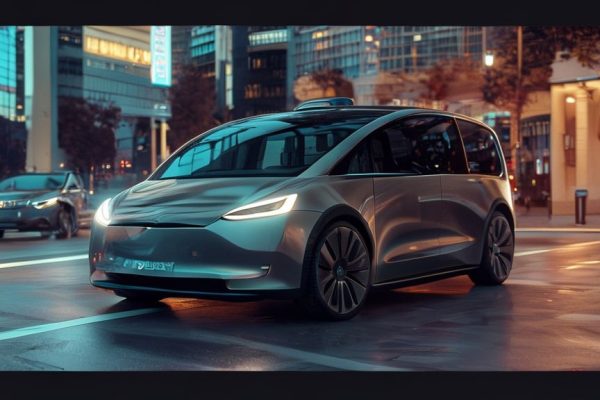
A futuristic illustration of a Tesla robotaxi navigating a crowded city street, with a sleek and minimalist design. The robotaxi is depicted in a neutral color scheme, with a subtle glow emanating from its sensors and navigation lights. In the background, a bustling cityscape with towering skyscrapers and bustling streets. The overall mood of the image should be one of optimism and possibility.






Leave a Reply