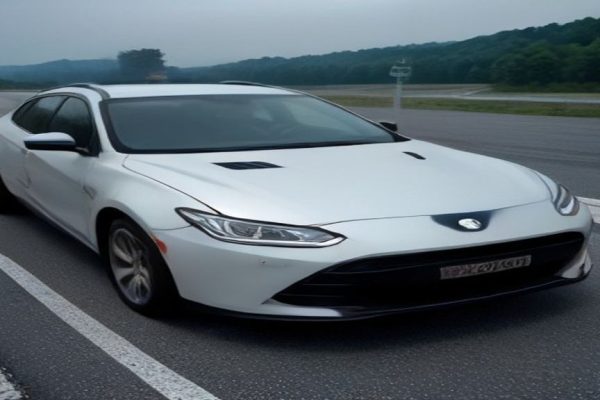
Chinese Automakers Push for Autonomy with Lidar Technology
Xinzhou Wu, a renowned expert in the field of autonomous driving, has been making waves with his recent statements on the future of Chinese cars. In an exclusive interview, Wu discussed the importance of lidar technology in achieving full autonomy and what this means for the Chinese automotive market.
Lidar, or Light Detection and Ranging, is a type of sensor technology that uses laser light to create high-resolution 3D maps of the environment. This technology has been instrumental in the development of autonomous vehicles, as it provides a highly accurate and detailed view of the surroundings. Wu believes that lidar will be a crucial component in the quest for full autonomy, allowing cars to navigate complex environments with ease.
The Chinese government has set ambitious targets for the adoption of autonomous vehicles, with a goal of having 50% of new cars sold in the country equipped with level 3 or higher autonomy by 2025. This has led to a surge in investment in lidar technology, with many Chinese companies, including leading automakers such as Geely and BYD, pouring significant resources into research and development.
The implications of this trend are far-reaching, with potential benefits for both consumers and the environment. Autonomous vehicles have the potential to greatly reduce traffic congestion, accidents, and emissions, making them an attractive option for cities looking to improve their transportation infrastructure.
The Role of Lidar in Autonomous Driving
Lidar technology plays a critical role in the development of autonomous vehicles, providing a highly accurate and detailed view of the environment. This allows cars to detect and respond to their surroundings in real-time, making them safer and more reliable.
Wu emphasizes the importance of lidar in achieving full autonomy, stating that ‘without lidar, it’s difficult to achieve the level of accuracy and detail needed for safe and reliable autonomous driving.’ He goes on to say that ‘lidar is not just a sensor, it’s a key component in the overall architecture of an autonomous vehicle.’
While lidar technology has made significant progress in recent years, there are still challenges to be overcome. One of the main issues is the high cost of lidar systems, which can make them prohibitively expensive for many consumers. However, Wu believes that as the technology continues to evolve, prices will come down, making lidar-equipped cars more accessible to the masses.
The Future of Chinese Autos: Trends and Predictions
The Chinese automotive market is expected to continue its rapid growth in the coming years, with many analysts predicting that China will become the world’s largest market for new cars within the next decade. Wu believes that autonomy will play a major role in this growth, stating that ‘autonomous vehicles will be a key driver of the Chinese automotive market, with many consumers looking to upgrade to level 3 or higher autonomy.’
However, there are also challenges ahead, including regulatory hurdles and public acceptance. Wu notes that ‘while there is a lot of excitement around autonomy, there are still many questions to be answered, including how to handle edge cases and what the implications are for jobs and the economy.’
Despite these challenges, Wu remains optimistic about the future of Chinese autos, stating that ‘the trend towards autonomy is clear, and China is well-positioned to take the lead in this space.’ As the technology continues to evolve, we can expect to see significant changes in the Chinese automotive market, with autonomy playing a major role in shaping the future of cars.
Xinzhou Wu’s insights provide a fascinating glimpse into the future of Chinese autos, highlighting the critical role of lidar technology in achieving full autonomy. As the trend towards autonomy continues to gain momentum, it will be exciting to see how the market evolves and what the future holds for consumers and the environment.
Image Prompt: A futuristic self-driving car navigating through a bustling cityscape, with a detailed 3D map of the environment created by lidar technology visible on the dashboard.






Leave a Reply