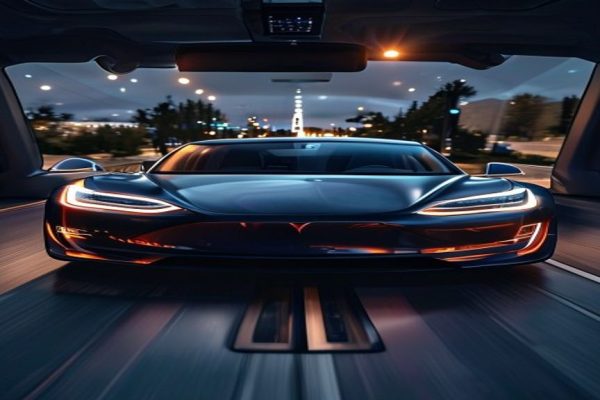
Tesla FSD Update: A Setback for Full Self-Driving Capability
The recent update on Tesla’s FSD (Full Self-Driving) capability has left many enthusiasts and investors wondering about the future of autonomous driving. According to a recent announcement, Tesla cars equipped with HW3 will not be receiving unsupervised FSD. This news has sparked a mix of reactions, ranging from disappointment to understanding, given the limitations of the hardware.
Understanding HW3 and Its Limitations
Tesla’s HW3 is the third generation of its Autopilot hardware. Introduced in 2016, it was designed to support advanced driver-assistance systems (ADAS) and eventually, fully autonomous driving. However, as the company has acknowledged, HW3 has its limitations. The hardware’s computing power and sensor suite are not sufficient to handle the complex tasks required for unsupervised FSD.
The HW3’s main limitation lies in its camera-based perception system. While it can detect and respond to certain objects and scenarios, it lacks the depth and accuracy needed for true autonomy. Additionally, the HW3’s processing power is not sufficient to handle the vast amounts of data required for FSD. This has led to a situation where Tesla is forced to rely on its more advanced HW4 hardware for FSD capabilities.
The Future of FSD: What’s Next?
The announcement has sparked concerns about the timeline for FSD development. While Tesla has made significant strides in autonomous driving, the HW3 limitation is a significant setback. The company has hinted at the development of more advanced hardware, but a precise timeline remains unclear. Investors and enthusiasts are eagerly awaiting updates on the company’s plans for FSD, as the technology has the potential to revolutionize the automotive industry.
In a statement, Tesla acknowledged the challenges associated with HW3 but emphasized its commitment to developing more advanced hardware. The company has already begun working on HW4, which promises to address the limitations of its predecessors. While this news may be a disappointment for some, it highlights the complexities involved in developing autonomous driving technology.
As the development of FSD continues, it’s essential to acknowledge the significance of hardware limitations. The update serves as a reminder that true autonomy requires substantial investments in research and development. Tesla’s commitment to pushing the boundaries of autonomous driving is unwavering, and the company is likely to make significant strides in the coming years.
Key Points:
- HW3 is not capable of unsupervised FSD due to its limitations in computing power and sensor suite.
- Tesla is working on more advanced hardware, including HW4, to address the limitations of its predecessors.
- The development of FSD is a complex process that requires significant investments in research and development.
- Tesla remains committed to pushing the boundaries of autonomous driving and is likely to make significant strides in the coming years.






Leave a Reply