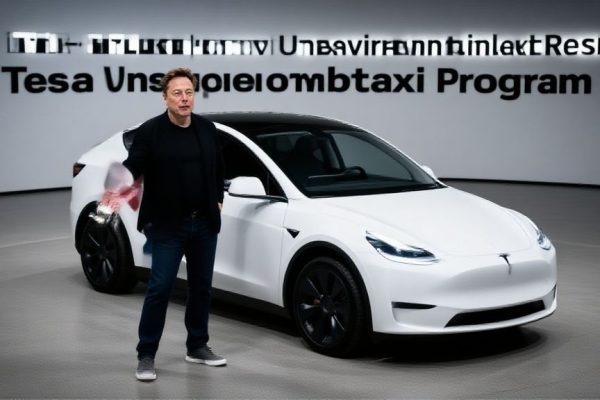
Tesla’s Unsupervised Robotaxi Program Reaches New Milestone
Elon Musk, the CEO of Tesla, has announced a significant milestone in the company’s unsupervised robotaxi program, which aims to enable fully autonomous vehicles to transport passengers without human supervision. The achievement marks a major step forward in the development of self-driving cars, but experts are cautioning that it may be some time before the technology is available to the general public.
Background and Context
Tesla’s unsupervised robotaxi program has been in development for several years, with the company investing heavily in the research and testing of its Autopilot technology. The system uses a combination of cameras, sensors, and machine learning algorithms to enable vehicles to navigate roads and traffic with minimal human intervention. While the technology has shown significant promise, it is still not widely available to consumers, and the company has faced numerous challenges in its implementation.
Reasons Behind the Delay
So, why is it unclear how many people will be able to ride in Teslas newly unsupervised robotaxis in the immediate future? There are several reasons behind the delay. Firstly, regulatory hurdles continue to pose a significant challenge for the adoption of autonomous vehicles. Governments around the world are still grappling with the implications of self-driving cars, and many have yet to establish clear guidelines for their use.
- Regulatory uncertainty: Governments are still figuring out how to regulate autonomous vehicles, which is a major obstacle to their adoption.
- Lack of public trust: Many people are hesitant to trust self-driving cars, which can be a major barrier to their adoption.
- Technical challenges: Developing and testing self-driving car technology is a complex and time-consuming process.
Secondly, the technology itself is not yet fully developed. While Tesla’s Autopilot system has shown significant promise, it is still not able to handle all scenarios and edge cases, and it requires human intervention in many situations. Finally, the company is likely to prioritize the development of its Full Self-Driving (FSD) technology, which is expected to be a more advanced and sophisticated system.
Future Implications
The implications of Tesla’s unsupervised robotaxi program are significant, and they have the potential to transform the way we travel. If successful, the technology could enable people to travel without the need for human drivers, which could improve road safety and reduce congestion. It could also enable new business models and services, such as ride-hailing and subscription-based transportation.
- Potential for improved road safety: Autonomous vehicles could reduce the number of accidents on the road, which could save lives and reduce injuries.
- Increased mobility: Self-driving cars could enable people who are unable to drive themselves to travel independently, which could improve their quality of life.
- New business opportunities: Autonomous vehicles could enable new business models and services, such as ride-hailing and subscription-based transportation.
Conclusion
Tesla’s unsupervised robotaxi program is a significant milestone in the development of self-driving cars, but it is unclear how many people will be able to ride in the vehicles in the immediate future. Regulatory hurdles, technical challenges, and a lack of public trust continue to pose significant challenges to the adoption of autonomous vehicles. However, if successful, the technology has the potential to transform the way we travel and could improve road safety, increase mobility, and create new business opportunities.
Image Prompt
An AI-generated image of a Tesla self-driving car navigating a busy city street, with the company’s logo prominently displayed on the side of the vehicle. The image should capture the sense of innovation and possibility that surrounds the development of autonomous vehicles, and it should convey the potential for the technology to transform the way we travel.





Leave a Reply