Tesla’s Autonomous Robotaxi Program Reaches Major Milestone
Tesla CEO Elon Musk has announced a significant breakthrough in the company’s push to develop fully autonomous robotaxis, capable of transporting passengers without human supervision. The development marks a major milestone in the company’s efforts to revolutionize the transportation industry with its Autopilot technology.
However, despite Musk’s enthusiasm, it remains unclear how many people will be able to ride in Teslas’ unsupervised robotaxis in the immediate future. The company’s push to develop autonomous vehicles has been ongoing for several years, with Musk repeatedly touting the technology as a key component of Tesla’s future success.
Background and Context
Tesla’s Autonomous Robotaxi Program has been in development for several years, with the company investing heavily in the research and development of its Autopilot technology. The technology uses a combination of cameras, radar, and sensors to enable vehicles to navigate roads and avoid obstacles without human intervention.
In 2020, Tesla began to roll out its Full Self-Driving (FSD) beta program, which allows select Tesla owners to test the company’s autonomous driving technology. However, the program has been plagued by issues, including concerns over safety and regulatory hurdles.
Future Implications and Hurdles
The development of Tesla’s autonomous robotaxis has significant implications for the transportation industry, with the potential to revolutionize the way people travel. However, there are also several hurdles that the company must overcome before its robotaxis can become a reality.
One of the main challenges facing Tesla is regulatory approval. In the United States, the National Highway Traffic Safety Administration (NHTSA) has issued guidelines for the development of autonomous vehicles, but the agency has yet to provide clear guidance on how to obtain approval for the deployment of unsupervised robotaxis.
Additionally, there are concerns over the safety of autonomous vehicles, with some experts warning that they may not be able to handle complex scenarios, such as construction zones or pedestrians stepping into the road.
Musk has repeatedly stated that Tesla’s autonomous technology is ready for deployment, but the company has faced several setbacks in its efforts to obtain regulatory approval. In 2022, the NHTSA issued a recall of Tesla’s FSD beta program, citing safety concerns.
Key Takeaways
- Tesla’s Autonomous Robotaxi Program has reached a major milestone, with the company announcing the development of fully autonomous robotaxis.
- Despite Musk’s enthusiasm, it remains unclear how many people will be able to ride in Teslas’ unsupervised robotaxis in the immediate future.
- The development of Tesla’s autonomous robotaxis has significant implications for the transportation industry, with the potential to revolutionize the way people travel.
- There are several hurdles that Tesla must overcome before its robotaxis can become a reality, including regulatory approval and safety concerns.
Tesla’s Autonomous Robotaxi Program is a major development in the company’s push to revolutionize the transportation industry. While there are still several hurdles to overcome, the potential for autonomous vehicles to transform the way people travel is significant. As the company continues to push the boundaries of what is possible with its Autopilot technology, it will be interesting to see how the industry responds to this emerging trend.
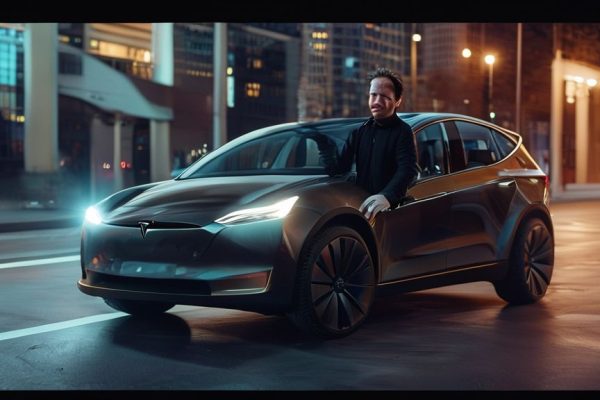
Image Prompt: A futuristic illustration of a Tesla robotaxi driving down a highway, with a cityscape in the background. The vehicle is depicted as being fully autonomous, with no human driver behind the wheel. The image should convey a sense of innovation and technological advancement, while also highlighting the potential for autonomous vehicles to transform the transportation industry.





Leave a Reply